November 20, 2026
I’m reopening a position in McBride plc (MCB.L) at a weighted average purchase price of 138.5p.
On August 28, I sold my entire McBride position at 208.5p, having generated a total return of approximately 83%, including dividends, over roughly one year.
Today, I’m buying the shares back at a price approximately 33.6% below my previous exit price.
What Happened?
On November 19, McBride issued a profit warning, expecting adjusted EBITA for FY2027 to come in 20–25% below the previous analyst consensus of £62.9 million. That implies approximately £47–50 million in adjusted EBITA.
The main issue is a slower-than-expected recovery in operating margins. Elevated raw material, packaging, energy and transportation costs have persisted, while operational challenges have delayed some pricing actions.
Management now expects margins to recover towards previous levels in Q4 FY2027 rather than Q2 FY2027.
However, underlying demand remains relatively resilient. First-quarter like-for-like volumes increased approximately 2%, while revenue grew around 4%, excluding the Eurotab acquisition.
The company also reports that its Eurotab integration and the transition activities for its major Vestacy manufacturing partnership remain on track.
Why I’m Buying Again
McBride operates in an industry with relatively stable underlying demand, although its profitability can be volatile due to input costs, customer pricing negotiations and operating efficiency.
The latest warning is disappointing, particularly because the expected margin recovery has been postponed again. But I don’t believe it necessarily represents a permanent deterioration in the underlying business.
McBride still benefits from its manufacturing scale, established customer relationships and the structural appeal of private-label cleaning products. Its recently announced Vestacy partnership also offers a potentially meaningful source of longer-term growth, although execution remains important.
At 138.5p, the shares trade at approximately 6.4 times FY2026 adjusted earnings per share. Of course, that multiple is backward-looking, and the weaker FY2027 outlook means it should not be mistaken for a sustainable forward earnings multiple.
The question is whether the current earnings pressure will prove temporary or reflect a more persistent weakness in the company’s economics.
I see enough potential for a recovery to make the valuation interesting again, while recognising that the risks have increased.
What Could Go Wrong?
The most obvious risk is that input cost inflation persists longer than expected or that McBride struggles to recover those costs through customer pricing.
The company also has meaningful financial obligations, and weaker profitability could put additional pressure on cash generation. Meanwhile, the Eurotab integration and Vestacy partnership introduce their own execution risks.
These are not insignificant concerns. A lower share price does not automatically make an investment attractive if the future earnings power of the business has deteriorated.
Nevertheless, at the current valuation, I believe the potential return justifies reopening a position.
As always, my official portfolio performance will be calculated using market closing prices rather than my actual execution price, consistent with Moat Mind’s established methodology.
The objective is not to trade McBride repeatedly, but to allocate capital when the expected return appears attractive relative to the available alternatives. After exiting in August, the combination of a materially lower share price and the company’s longer-term prospects has brought McBride back into the portfolio.
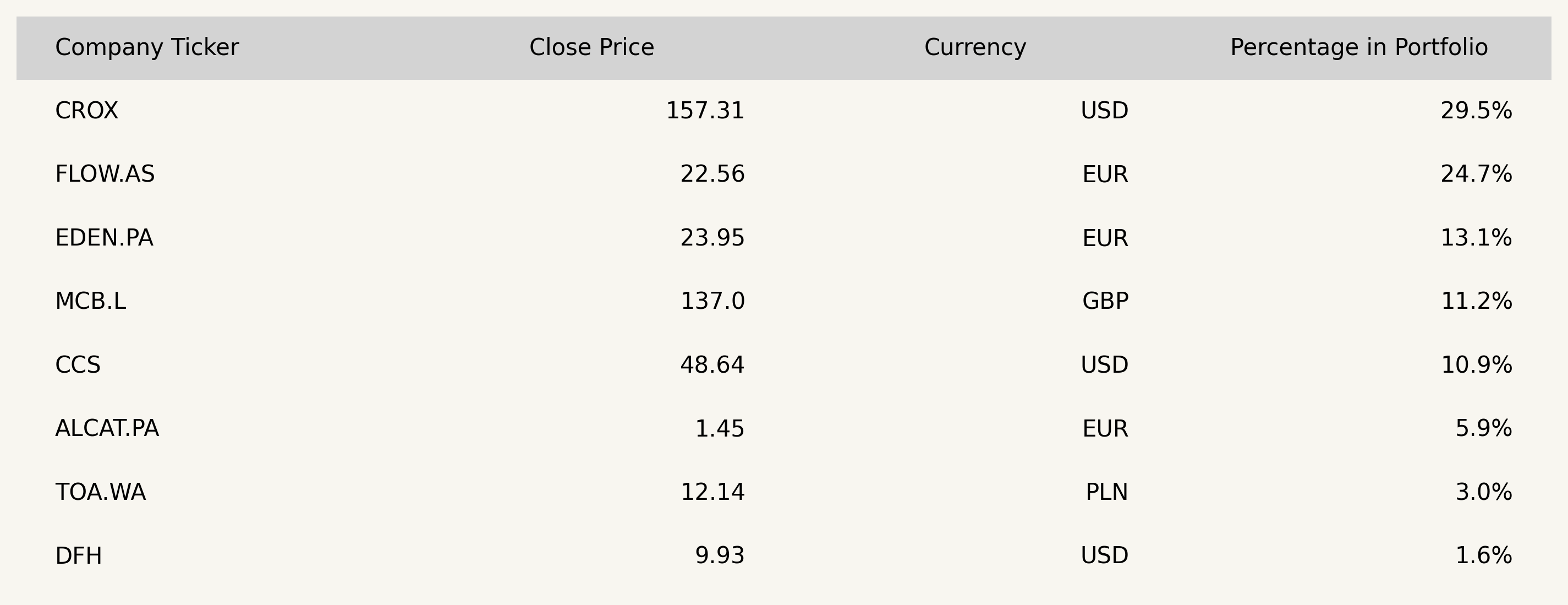
Following the re-entry into McBride, MCB.L now represents 11.2% of the portfolio, making it our fourth-largest holding. The portfolio remains concentrated, with Crocs and Flow Traders together accounting for 54.2% of its value.